

Keeping Bees

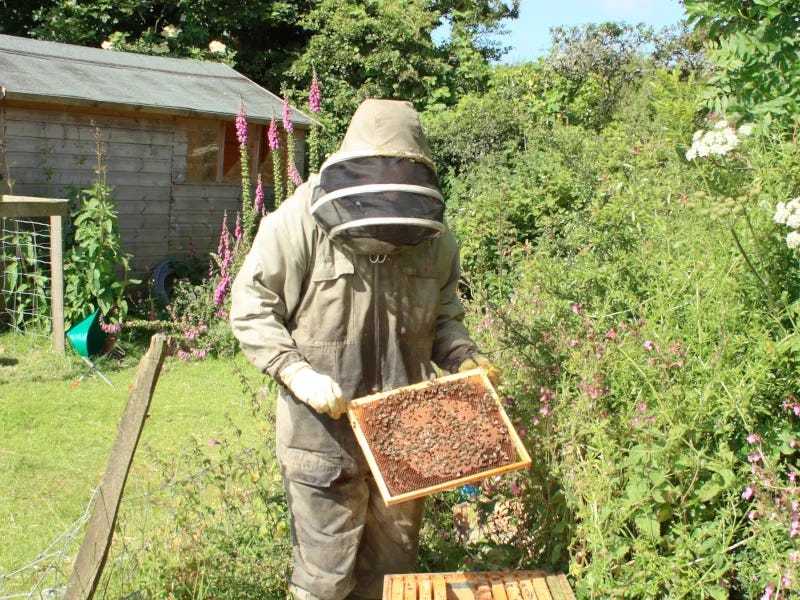
I keep bees.
There, I’ve said it, like a quiet admission at a support group meeting. It’s a phrase that tends to land in different ways depending on who’s listening. I’ve been a professional, commercial-scale beekeeper for nearly thirty years and the reactions have always been mixed. Sometimes it’s met with a broad smile and a cascade of questions, other times, just a pause, an uncertain look and a silence that suggests people aren’t quite sure what to say next while the unspoken message is “what a weirdo!”.
The truth is, I’m not entirely sure what I mean by it either.
“I keep bees” is the phrase we all use but I’ve never been completely comfortable with it, both as a word and as a concept. It implies that something is being held and contained against its will but bees resist that framing. They are not livestock in any straightforward sense, nor are they companions in the way we understand pets. They come and go as they please, they organise themselves according to their own internal logic and at any moment they retain the ability to leave entirely.
So what does it mean to “keep” something that cannot truly be kept?
Perhaps the phrase says more about us than it does about them. It reflects a habit of mind, the tendency to name, to frame, to assume a position of control over the living world. Yet the longer you spend with bees, the more that assumption begins to erode. Control gives way to influence, influence to observation, and observation, if you’re paying attention, to a kind of humility.
I use the phrase because it’s convenient, because it communicates something quickly, but it has never felt entirely accurate to me. If anything, it is a relationship of proximity rather than possession. Perhaps, as usual, I’m overthinking it.
Anyway, I’ll say it again.
I keep bees.
People often assume that beekeeping is all about honey. That’s the visible outcome, a product, the thing that can be jarred, labelled, and sold, the part that fits neatly into an economic narrative and is the raison d’etre for many beekeepers. But honey, for me, has never really been the point. It is a consequence, not a purpose.
Like eggs from chickens, honey can be a result of keeping bees but it is not guaranteed. There are many times when the bees need me. Years shaped by poor weather, disrupted forage or prolonged dearth have made it clear that what appears to be abundance can, very quickly, become scarcity.
Which raises a more fundamental question: why keep bees at all?
Beekeeping has a quiet but remarkably swift way of altering perception. It changes not just what you see but how you see. Attention sharpens and the world becomes more detailed, more interconnected, less easily taken for granted. What once felt like background - the weather, the hedgerows, the timing of flowering plants - moves into the foreground with sharper focus.
You begin to read the landscape differently. Not as scenery, but as a system. A network of relationships in constant negotiation between plants and pollinators, soil and weather, human intention and ecological consequence. You notice not just presence, but absence. Not just abundance, but fragility.
In doing so, it becomes harder to maintain the illusion that we stand apart from it.
Beekeeping, in this sense, is not really about bees. It is about the ideas that gather around them, how we understand nature, how we justify our use of it, how we reconcile productivity with responsibility. It touches on farming, on land use, on sustainability and on the often uneasy relationship we have with the living systems that sustain us.
Bees do not resolve these questions but they do make us ask them and make them harder to ignore.
Most of all though, you come to realise that bees themselves are endlessly interesting. A colony is not simply a collection of individuals but a distributed intelligence, responsive, adaptive and deeply integrated with its environment. It behaves as a whole, yet is made up of thousands of parts, each following simple rules that somehow result in complex, coordinated outcomes. Described as a ‘superorganism’, a colony of bees is one of the most complex biological systems people can observe at close range.
It is, in many ways, a reminder that intelligence does not always look the way we expect it to.
You can spend years observing a colony and still feel that you are only glimpsing fragments of a much larger process. There is always something just beyond full understanding, something that resists being fully reduced to explanation.
If for no other reason, this alone is reason enough to keep bees. They are teachers but not in any straightforward sense and like good teachers, they do not instruct, they reveal and what they reveal depends largely on the quality of your attention. The education they offer is constant but never complete.
There’s an old beekeeping adage: “Keep bees for three years, and you’ll keep them for a lifetime.” It alludes to the fact that many beginners (in fact, most) will give up within those first years but those that don’t will pursue that endless interest. Not because it becomes easier but because it becomes deeper.
I am one of those people.
However, with time, another realisation begins to take shape. The longer I keep bees, the more I become aware of the limit of what I know, the limits of what I can know and the seeming limitlessness of what I do not know. Experience does not resolve the uncertainty, it refines it. It replaces simple questions with better, more difficult ones.
However long I do this, however much I read, learn and experience, there will always be more that escapes me, much more that sits just beyond reach.
Perhaps that is the point because in the end, beekeeping is not about arriving at an understanding but about remaining in the process of trying to understand. It is a practice of attention, of patience and of accepting that the living world is not something to be mastered. It is something to be engaged with, carefully, imperfectly and with a degree of respect that grows over time.
One lifetime is not enough.
Maybe it was never meant to be, but “… is there honey still for tea?”